YouTube Sponsorship
Rate Calculator 2026
By the YTCalculators Research Team · Last updated: June 2026
The free YouTube sponsorship rate calculator for 2026. Enter your views, niche, and audience — get an instant brand deal rate estimate.
$100
Finance CPM
1.8×
US Audience Premium
12.5k+
Rates Calculated
Get Your Sponsorship Rate
Edit any field — results update instantly.
Step 1
Channel Details
Step 2
Rate Estimate
Rates based on 500+ brand deal contracts · See methodology →
Rates by Placement Type
All placement options for your inputs
| Placement | Rate |
|---|
Negotiation Tips For You
Show Package Pricing
| Package | Per Video | Total | Savings |
|---|
How Is This Calculated?
Step-by-step formula breakdown for your inputs:
Share your rate
Your rate will appear here
Fill in your channel details and click Calculate
What Creators Are Saying
"I was quoting $800 for integrations. This showed me Finance creators should charge way more — closed my next deal at $2,400."
@justinfinance_yt
Finance Creator
"Finally a calculator that handles geo and placement separately. The US audience premium section alone changed how I pitch brands."
@sarah_techreviews
Tech Creator · 85k subs
"The placement breakdown table is gold. I use it to show brands exactly why a dedicated video costs 2× a 30-second mention."
@marcgaming
Gaming Creator · 210k subs
How It Works
Our sponsorship rate calculator uses 10 niche CPM benchmarks and 5 geography multipliers to tell you exactly how much to charge for a YouTube sponsorship — whether you're a micro-influencer or a 1M+ creator.
Step 1
Enter Your Stats
Input your subscriber count, average views, engagement rate, niche, and audience geography.
Step 2
Get Instant Rates
Our engine calculates conservative, recommended, and premium rates using 10 niche CPM benchmarks and 5 multipliers.
Step 3
Negotiate Confidently
Use your personalized tips and full placement rate table to pitch brands with data-backed confidence.
How YouTube Sponsorship Rates Are Calculated
YouTube sponsorship rates are not calculated the same way as AdSense earnings. While AdSense pays based on ad revenue sharing, sponsorship rates are negotiated directly between creators and brands. The foundation of sponsorship pricing is the sponsorship CPM — how much a brand is willing to pay per 1,000 views to have their product mentioned in your video.
Unlike AdSense CPM (which averages $3–$10 for most niches), sponsorship CPM ranges from $20 for entertainment channels all the way to $100+ for finance and B2B SaaS channels. This is because brands are buying targeted audience attention, not just impressions.
Average views matter more than subscriber count. Brands care about guaranteed eyeballs, not your total follower number. A creator averaging 80,000 views per video is worth more to a brand than one with 500,000 subscribers averaging 8,000 views.
Our calculator applies niche CPM × average views, then adjusts for audience geography, engagement rate, placement type, channel authority, upload consistency, and add-ons like exclusivity and usage rights.
Average YouTube Sponsorship Rates By Niche
Based on industry CPM benchmarks and creator deal data.
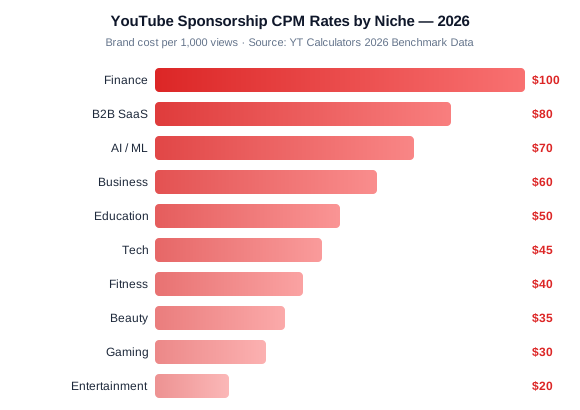
| Niche | Avg CPM | Rate Range |
|---|---|---|
| Finance Top | $100 | $5k – $25k |
| B2B SaaS Top | $80 | $4k – $20k |
| AI / Machine Learning Top | $70 | $3.5k – $18k |
| Business | $60 | $3k – $15k |
| Education | $50 | $2.5k – $12k |
| Tech | $45 | $2k – $11k |
| Fitness & Health | $40 | $2k – $10k |
| Beauty & Fashion | $35 | $1.5k – $9k |
| Gaming | $30 | $1.5k – $8k |
| Entertainment | $20 | $1k – $5k |
* Rates shown for a 30-second integration at the selected audience geography. Rate ranges reflect typical deal variation across engagement tiers.
YouTube Sponsorship Rates By Subscriber Count
Typical rates for a 30s integration and dedicated video. Assumes average engagement.
| Subscriber Tier | 30s Integration | Dedicated Video |
|---|---|---|
| 1k – 10k | $50 – $200 | $150 – $600 |
| 10k – 50k | $200 – $800 | $600 – $2,500 |
| 50k – 100k | $500 – $2,000 | $1,500 – $6,000 |
| 100k – 500k | $1,000 – $5,000 | $3,000 – $15,000 |
| 500k – 1M | $3,000 – $10,000 | $9,000 – $30,000 |
| 1M+ | $8,000 – $25,000+ | $25,000 – $75,000+ |
* Finance, B2B, and tech channels command 2–4× these rates. Rates already include your selected geography multiplier.
What Factors Increase Your Sponsorship Rate
Understanding which variables move the needle helps you grow sponsorship income strategically — not just by chasing subscriber count.
Engagement Rate
An engagement rate above 4% signals a highly active audience. Brands pay a 30–60% premium for channels where the audience actually responds. Prioritize comments and community interaction over pure view count.
Audience Geography
US, UK, and Canadian audiences are worth 2–2.5× more to advertisers than global mixed audiences. A channel with 60%+ US viewers can charge double the rate of an identical channel with a primarily Indian or Southeast Asian audience.
High-Value Niche
Finance, B2B SaaS, and AI channels command 3–5× the CPM of entertainment or gaming channels. Their audiences have higher purchasing power and software brands have much larger marketing budgets.
Exclusivity & Usage Rights
Exclusivity clauses deserve a 25%+ premium. Usage rights — allowing the brand to repurpose your footage in paid ads — add another 50% since you're creating an asset, not just an impression.
Upload Consistency
Channels that upload 2+ videos per week are perceived as more reliable. Consistent creators get repeat deals and earn premiums for predictability. An inconsistent upload schedule is a negotiation liability.
Audience Quality & Demographics
Decision-makers, professionals, and high-income audiences are worth significantly more. If your analytics show 25–45 age range, professional occupations, or high household income, highlight this in your media kit.
How to Negotiate Better Brand Deals
Most creators leave significant money on the table by not knowing how to negotiate. Here are the tactics that consistently result in higher rates:
Anchor high, always.
Your first number should be your premium rate — not your recommended rate. Negotiation is a downward movement from your anchor. If you start with your recommended rate, you'll end up settling below market value.
Lead with a media kit.
Before quoting any number, send a professional media kit with your average views, engagement rate, audience demographics, and past brand partners. Creators with media kits earn 30–40% more per deal on average.
Package deals increase total value.
Instead of one video at $1,000, pitch a 3-video package at $2,500. Monthly retainers (4 videos/month) can lock in 3–5× your per-video rate and give brands the consistency they need.
Charge a premium for exclusivity.
When a brand wants you to avoid all competitor mentions for a period, that is an opportunity cost. Price it at 25–50% above your standard rate minimum.
Counter every lowball offer.
If a brand comes in at half your rate, don't accept. Counter with your recommended rate and explain why. Data-backed counters referencing your engagement rate and audience quality close at 60%+ success rate.
Know when to walk away.
If a brand insists on rates below your conservative estimate, politely decline. Underpriced deals set a market expectation and devalue your channel for future partners.
How We Calculate Your Rate Formula, data sources, and why we show 3 tiers
rate = (avgViews × nicheCPM / 1000)
× geoMultiplier // 0.45 – 2.0× based on audience geography
× engagementMultiplier // 0.7 – 1.6× based on engagement rate
× placementMultiplier // 0.3 – 2.0× based on sponsorship type
× subAuthorityBonus // 0.7 – 2.0× based on subscriber count
× consistencyBonus // 0.9 – 1.1× based on upload frequency
× channelAgeBonus // 0.9 – 1.1× based on channel age
× exclusivityPremium // +25% if exclusivity requested
× usageRightsPremium // +50% if usage rights included
Starting point for new brand relationships, dream-brand discounts, or creators with limited sponsorship history.
The market-rate for your tier. Back this number with your media kit and engagement data.
Appropriate for brands with large budgets, US-heavy audiences, high engagement, or exclusive long-term deals.
Data sources informing our CPM benchmarks:
- · Creator Economy Live 2025 Benchmark Report
- · Influencer Marketing Hub Creator Rate Report (2025–2026)
- · IZEA State of Influencer Marketing 2025
- · Grin Creator Marketing Report
- · Aggregated publicly-reported creator deal data
Browse Sponsorship Rates By Category
Explore detailed rate benchmarks for every niche, subscriber tier, country, and placement type.
By Channel Niche
By Subscriber Count
By Audience Country
By Placement Type
Sponsorship Guides & Resources
New to sponsorships? Start with our complete guide →
How sponsorships work, what they pay, how to negotiate, FTC rules — everything in one place.
How to get your first YouTube sponsorship →
Step-by-step: media kit, pitch email, platform sign-up, and rate negotiation.
For brands: what does a YouTube sponsorship cost? →
Budget guide for advertisers — CPM by niche, channel size pricing, ROI measurement.
YouTube Sponsorship Rate Quick Answers
What Is a YouTube Sponsorship Rate?
A YouTube sponsorship rate is the fee a creator charges a brand for featuring their product or service in a video. Rates are typically structured as a flat fee per video — not based on ad impressions — and are negotiated directly between the creator and the brand. The rate reflects the creator's average views, niche CPM, audience geography, engagement rate, and placement type (30-second integration, 60-second integration, or dedicated video).
How Much Should a YouTuber Charge for Sponsorships?
A YouTuber should charge based on their average views per video, not their subscriber count. The standard formula: multiply your niche CPM by your average views divided by 1,000, then apply multipliers for audience geography (US audiences command 1.8–2.0× the global rate), engagement rate, and placement type. For example, a Tech creator averaging 30,000 views with a US-heavy audience should charge approximately $2,000–$4,000 for a 60-second integration. Use the calculator above to get your personalized rate.
How Are YouTube Sponsorship Rates Calculated?
YouTube sponsorship rates are calculated using a sponsorship CPM (cost per 1,000 views) multiplied by the creator's average views, then adjusted with several multipliers: audience geography (0.45× for India-primary to 2.0× for US+UK+Canada), engagement rate (0.7× for under 0.5% engagement to 1.6× for 6%+ engagement), placement type (0.3× for Shorts to 2.0× for dedicated video), subscriber authority, and upload consistency. The final rate represents what brands in that niche typically pay per 1,000 targeted views.
What Is a Fair CPM for YouTube Sponsorships?
A fair sponsorship CPM for YouTube ranges from $20 (entertainment/gaming) to $100+ (finance/B2B SaaS), depending on niche. Finance channels command $100 CPM because brands pay more to reach high-income professionals with buying intent. Tech channels average $45 CPM. Gaming channels average $30 CPM due to younger demographics and global mixed audiences. These CPMs are 5–20× higher than AdSense RPM because brands are buying targeted audience attention, not just ad impressions.
Free YouTube Creator Tools
Five free tools to calculate your rates, estimate income, and pitch brands — no signup required.
Sponsorship Rate Calculator
You are hereCalculate exactly how much to charge brands based on views, niche, engagement, and audience geography.
CPM Calculator
See per-video, monthly, and annual revenue from sponsorship CPM rates across all 10 niches.
Earnings Calculator
Estimate your combined AdSense and brand sponsorship income with a full breakdown.
Money Calculator
Project monthly and annual income range — low, typical, and high scenarios.
Media Kit Generator
Generate a professional media kit with your rates and audience data ready to send to brands.
View All Tools
See the full tool suite with a comparison table and step-by-step workflow guide.
Frequently Asked Questions
Everything you need to know about YouTube sponsorship pricing.
The amount depends on your niche, average views, engagement rate, and audience geography. A creator with 50,000 views per video in the finance niche can reasonably charge $2,500–$5,000 for a 60-second integration. The standard formula is: Niche CPM × (Average Views ÷ 1,000) × Geography Multiplier × Placement Multiplier. Finance channels command $100 CPM while entertainment channels average $20 CPM. Always anchor at your premium rate and negotiate down — never start low.
YouTube sponsorship rates are calculated using a sponsorship CPM (cost per 1,000 views), multiplied by your average views, then adjusted for niche, audience geography, engagement rate, and placement type. Unlike AdSense CPM (which averages $3–$10), sponsorship CPM ranges from $20 (entertainment) to $100+ (finance/B2B SaaS). Key multipliers include: audience geography (0.45× for India to 2.0× for US+UK+Canada), engagement rate (0.7× to 1.6×), and placement type (0.3× for Shorts to 2.0× for dedicated video).
No — average views per video matter far more than subscriber count. Brands pay for guaranteed eyeballs on their message, not your total follower count. A channel with 10,000 subscribers averaging 50,000 views per video is worth more to a brand than one with 500,000 subscribers averaging 5,000 views. Always price sponsorships based on your average views, and focus on improving your view-to-subscriber ratio.
Brands pay widely varying sponsorship CPMs depending on niche: Finance and B2B SaaS brands pay $60–$100 CPM, AI and tech brands pay $45–$70 CPM, education channels see $40–$60 CPM, and entertainment channels typically see $15–$25 CPM. These sponsorship CPM rates are 5–20× higher than AdSense RPM because brands are buying targeted audience attention and purchasing intent, not just ad impressions.
Price based on average views, not subscribers. If you average 3,000 views per video in a tech niche with a US-heavy audience, a 30-second integration can realistically command $200–$400. For a dedicated video, expect $600–$1,500. Micro-creators with small but highly engaged audiences in premium niches (finance, B2B, AI) can charge significantly more. Focus on building average views and engagement before aggressively pitching brands.
A 100k channel in a premium niche (finance, tech, B2B) averaging 30,000–50,000 views with a US-heavy audience can realistically charge $3,000–$8,000 for a dedicated video and $1,500–$4,000 for a 60-second integration. High engagement (4%+) and a consistent upload schedule can push rates even higher. Entertainment and gaming channels at 100k should expect lower rates: $500–$2,000 for a 60-second integration.
The main factors are: (1) Average views per video — the primary pricing driver; (2) Channel niche — finance and B2B SaaS pay the highest CPM at $80–$100; (3) Audience geography — US, UK, and Canadian audiences command 1.8–2.0× the rate of global mixed audiences; (4) Engagement rate — above 4% qualifies for a 30–60% premium; (5) Placement type — dedicated videos cost 2× a 30-second integration; (6) Exclusivity clauses add 25%; (7) Usage rights add 50%; and (8) Channel authority including age and upload consistency.
Brands typically pay $20–$100 per 1,000 views for YouTube sponsorships depending on niche. Entertainment channels see approximately $20 CPM, gaming channels $30 CPM, tech channels $40–$50 CPM, and finance channels $80–$100+ CPM. These are sponsorship CPM rates — not AdSense rates. AdSense RPM is typically 3–10× lower because it pays for ad impressions, while sponsorship CPM reflects the value of targeted audience attention and purchasing intent.
Most creators charge a flat fee per video, which is the industry standard. Flat fees provide predictable income and protect you from underperforming videos. CPM-based deals are risky because they tie your income to actual views, which can vary. Only consider CPM deals if a brand offers a rate significantly above your standard sponsorship CPM. Always negotiate based on your average views from the past 30–90 days, not projected or best-case views.
Key negotiation tactics include: (1) Anchor high — always quote your premium rate first, not your minimum; (2) Lead with a professional media kit showing average views, engagement rate, and audience demographics; (3) Counter lowball offers with data — reference your CPM, engagement, and audience quality; (4) Package multiple videos to increase total deal value; (5) Charge 25–50% premium for exclusivity clauses; (6) Charge 50% extra for usage rights; (7) Never accept product-only payment unless it has genuine high retail value.
YouTube AdSense CPM (or RPM) is the revenue YouTube shares with creators from its ad auction system, typically averaging $3–$10 for most niches. Sponsorship CPM is the rate a brand directly pays a creator per 1,000 views on a sponsored segment, ranging from $20–$100+ depending on niche. Sponsorship CPM is 5–20× higher because brands are buying guaranteed, dedicated audience attention with a personal endorsement — far more valuable than a skippable ad impression.
Finance YouTube channels command the highest sponsorship CPM at approximately $100 per 1,000 views. A finance creator averaging 100,000 views per video with a US-heavy audience can charge $8,000–$25,000 for a dedicated video, $5,000–$10,000 for a 60-second integration, and $1,500–$3,000 for a Shorts mention. Finance channels earn premium rates because their audiences have high purchasing power and financial brands have large marketing budgets targeting high-net-worth individuals.
Yes — audience geography is one of the most impactful factors in sponsorship pricing. US, UK, and Canadian audiences command a 1.8–2.0× multiplier compared to a global baseline. Channels with 60%+ US viewers can charge roughly double the rate of an identical channel with a primarily Indian or Southeast Asian audience (which carries a 0.45× multiplier). When pitching brands, always highlight your US/Tier-1 audience percentage in your media kit.
YouTube sponsorships are direct paid partnerships between a creator and a brand. A brand pays the creator a flat fee to mention, review, or feature their product within a YouTube video. Unlike AdSense, sponsorships are negotiated and contracted directly — the creator keeps 100% of the payment. The creator discloses the paid partnership per FTC guidelines and delivers a dedicated 30–90 second segment in the video. Payment is typically invoiced net-30 or net-60 after the video publishes. Sponsorship CPMs range from $20 (entertainment) to $100+ (finance), making brand deals the primary income source for most mid-size creators.
YouTube sponsorships pay between $50 and $75,000+ per video depending on channel size and niche. The median sponsorship CPM across all niches is approximately $52.50, meaning a creator averaging 30,000 views per video earns around $1,575 per 30-second integration. Finance channels ($100 CPM) earn 5× more per view than entertainment channels ($20 CPM). At 100,000 subscribers, typical sponsorship income ranges from $500–$2,500 per video (entertainment/gaming) to $3,000–$10,000 per video (finance/B2B). Use the free calculator above to see your personalized estimate.
Grow Your Channel
Tools used by top YouTubers to attract better sponsorships and grow their channels faster.
Affiliate disclosure: Links below are sponsored. We may earn a commission at no extra cost to you.
TubeBuddy
The #1 YouTube SEO tool. Optimize titles, tags, and thumbnails to grow faster and attract better brand deals.
Try TubeBuddy Free →vidIQ
Keyword research and competitor analysis built for YouTube creators. Used by 20M+ creators worldwide.
Try vidIQ Free →Beehiiv
Build a newsletter to own your audience beyond YouTube. Newsletter subscribers convert 10x better than views alone.
Start with Beehiiv →